General
Navigating The 2026 Alberta Referendum Questions
September 29, 2026
The Government of Alberta is holding a referendum on October 19, 2026 ».
The balloted questions run from topics of immigration, provincial & federal jurisdictions, and whether to hold another referendum on leaving Canada. The results have no legal binding on the government’s actions, and it is an expensive, blustery use of taxpayer money — $100 million more than a provincial election (or about as much as a federal election costs) ».
Alberta’s 2026 referendum questions are also incredibly anti-immigrant and anti-immigration. While many of the ballots present simple ideas at a glance, the language used within the referendum questions require more than a University degree to understand fully. However, most of the questions boil down to creating additional red tape for immigrants in Alberta. Scapegoating racialized populations is neither a replacement for sound political policy nor competent government. Alberta is a place for everyone; even for out-of-town politicians who want to wear cowboy hats while flipping non-denominational pancakes.
We did not re-write or re-interpret any of the questions in this analysis because the Alberta government very deliberately chose to word their questions in the way that they did. We encourage you to read through the questions on your own or contact your MLA (instructions near the end here) for help understanding what you are being asked.
As with anything you read, be careful and think critically if anyone is re-wording the questions for you, as all translations involve some degree of bias or judgment.
assume (verb)
to take to or upon oneself : assume responsibility
to place oneself in : assume a position / assume control
to pretend to have or be : assumed an air of confidence in spite of her nervousness
to take as granted or true : I assume he’ll be there.
For example, the word “assuming” shows up in two of the referendum questions, which is not a word commonly associated with certainty. Does the government assume you will answer these questions honestly? Do you assume the gas pump is correct when you fill up your car?
(If you want to skip ahead to our recommended answers, click here »!)
A referendum is a political tool also known as a plebiscite or ballot measure. A typical referendum is similar to voting in an election, though sometimes there can be multiple options or questions to answer. If the results are binding, a referendum can be a really powerful way for the populace to get their say on a particular issue. If the results are non-binding (like this one), they reflect something closer to an opinion poll or voter survey.
The last referendum in Alberta was about equalization payments and Daylight Savings Time (DST), introduced by then-Premier Jason Kenney’s UCP government; Kenney was previously responsible for helping create and implement the equalization formula as part of the federal government in previous years ». The DST referendum question was rejected by 50% of Albertans, though the UCP has ultimately decided to make those time zone changes regardless ». And they say referendums don’t go anywhere!
Some Albertans want the province to leave Canada: around one third of Albertans polled say the province should “commence the legal process for a binding separation referendum” ». The same poll found that of this thirty-three percent, nearly half of them say “it’s about sending a message to Ottawa”. What gets exposed here is that political grievances in this province have been fueled by a desire to see the federal government under a Conservative Party banner, mostly. You can see this in the way our elected officials still talk about Justin Trudeau (via the Liberal Party of Canada), who has not been Prime Minister of Canada since 2025.
For historical purposes, it’s important to note that Quebec has visited this entire separation referendum process in the past; the movement ultimately failed despite a close voting record and much back-and-forth between the federal and provincial government at the time. Albertans will argue until the cows come home about what our shared culture is, but the province of Quebec has its own unique cultural identity due in large part to the French language and history.
An individual can draw as many lines in the sand as they want, but people (and the way they are connected to one another) are the ingredients that make a sovereign nation work.
The same reason kids move out of their parents’ houses: they think they can take a stab at living independently.
We won’t go over all the reasons why Albertans want to leave, but there are certainly complications that arise from even doing it as a thought experiment. If our post-pandemic years taught us anything, it’s that: people are irrational, online misinformation is rampant, and no one is immune to propaganda. The COVID-19 pandemic and each government’s responses to it have reshaped the way many people engage with the world over the last several years.
As discussed previously, a majority of the pro-separation Albertans argue this is the way to send a message to the federal government in Ottawa. Do they actually want Alberta to separate from Canada? That’s harder to discern, but I think many of them believe it’s better than their current situation (whatever that may be). Do they want Alberta to be part of the United States of America? Possibly. It’s difficult to imagine any scenario where Alberta separates and is not immediately contested territory between the two bordering nations, if this process and discussion even drag on that far.
To note, the province of Alberta does not have a military to oppose occupation, is landlocked, and imports many goods from out-of-province and out-of-country. Every federal program would have to be duplicated in one fashion or another, from food safety and aircraft transportation regulations to immigration and disaster relief. The province commissioned the University of Calgary to produce a report that estimates it will cost at least $170 billion dollars to separate and that, in either good or bad scenario, “a typical worker would earn almost $5,500 less than if Alberta had not separated” ».
Danielle Smith’s UCP has helped the Alberta separation cause, including changing the election rules several times to their benefit before adding the separation question to the referendum itself.
Is Alberta the Texas of the north? Maybe.
Do Albertans want to be the 51st state? Probably not.
Is Premier Smith standing up for Albertans? A few, maybe.
…With that rigamarole out of the way, let’s review the questions!
Do you support the Government of Alberta taking increased control over immigration for the purposes of decreasing immigration to more sustainable levels, prioritizing economic migration and giving Albertans first priority on new employment opportunities?
No.
The provincial government of Alberta spent millions calling for Canadian migrants and immigrants to come to the province, only to pull the rug out from under many of them. The Alberta Is Calling campaign offered a potential moving bonus of $5,000 tax-free to workers who packed their bags for the prairies », and tens of thousands of workers from other provinces came to Alberta as a result ». Premier Danielle Smith in 2024 even discussed her hopes for Red Deer growing ten times its size, from about one hundred thousand residents to one million ».
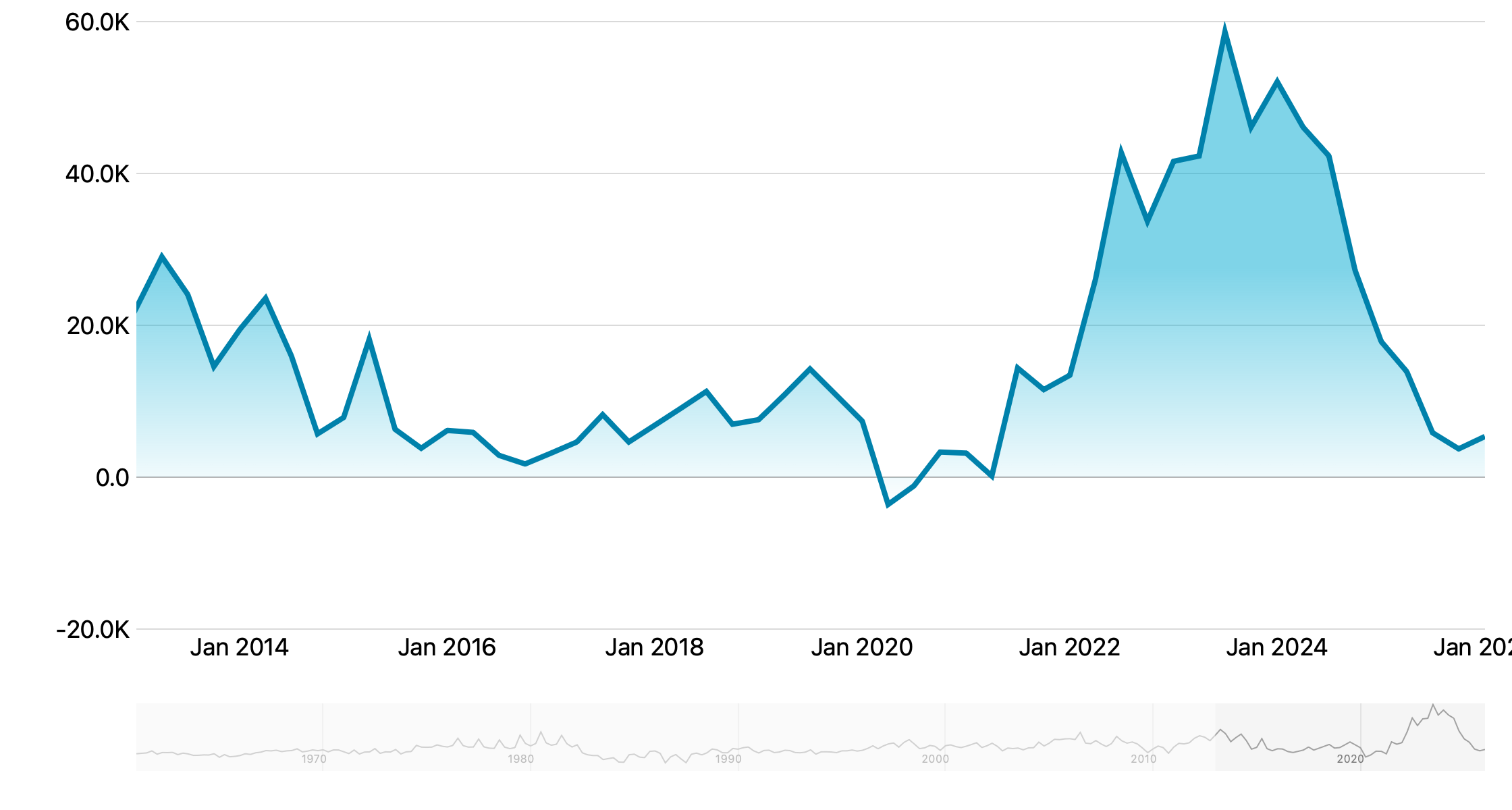
For the record: net migration to the province of Alberta has been dropping since 2024, as shown in the chart below.
In early 2024, Premier Danielle Smith sent a letter to then-Prime Minister Justin Trudeau, asking that the province be offered over double the amount of Provincial Nomination Program applicants ». The numbers, however, show that the UCP has managed high immigration levels since 2020, making the case for increased immigration a strange request while program funding has not kept pace with per capita population growth. If you look at the chart above, you can see that Ms. Smith’s letter to PM Trudeau occurred around or after migration to the province had already peaked.
Why would Premier Smith then say that “temporary residents shouldn’t receive full benefits” »? In her letter, she mentions “Ukrainian evacuees”. Will Ukrainians fleeing from war have completed all of their citizenship paperwork to access whatever benefits are left to offer in Alberta? Refugees fleeing violence should not be put in any worse a situation than someone immigrating through other channels; witholding benefits and services from those who need them most is the work of a government that does not care about people’s wellbeing.
There is no hard evidence to suggest that Alberta residents are being looked over in favour of migrant workers; in fact, the reverse is likely to be true for some of the most labour-intensive work in the province (for example, farming, meat processing », construction). There is also ambiguity in navigating labour laws that are not from your original country; many immigrants could be taken advantage of because they do not know all of their rights or are afraid of the repercussions their employer could bring down on them or their families.
The Alberta government claims that immigrants create one billion dollars in extra service costs, but neglects to account for these numbers in great detail. From their FAQ page » we can see:
Until they decide to give us more information, we can only speculate whether these figures are rooted in fiction or fact; meanwhile, immigrants and immigrant families are the ones who suffer when the government makes baseless generalizations such as these. Racism and bigotry against immigrants in Alberta is growing worse, and Premier Smith seems intent on stoking those flames higher».
A reminder for folks at home: whether you are a visitor, migrant, temporary worker, or Alberta resident you likely pay several taxes on any wages you make (ie. EI / CPP) as well as on most purchases (ie. GST, Recycling & Enviro fees). If the province wanted to, they could institute a Provincial Sales Tax (PST) or Harmonized Sales Tax (HST) at any time, joining the rest of the provinces and territories in collecting additional sales tax towards provincial coffers. Increasing Alberta’s lowest-in-the-country minimum wage would also increase the amount of taxes Albertans pay.
| Topic | Populations Impacted | Reading Level | What’s Left Out |
|---|---|---|---|
| Immigration | Immigrants, temporary foreign workers, international students | Post-graduate Very hard to read |
What are “sustainable levels”? |
Do you support the Government of Alberta introducing a law mandating that only Canadian citizens, permanent residents and individuals with an Alberta-approved immigration status will be eligible for provincially-funded programs, such as health care, education and other social services?
No.
Immigration is a federal concern because it involves dealing with things like: borders, passports, and international law. These are not within the current provincial purview and would fall far outside of the scope and capabilities of a provincial body. As we’ve discussed with the earlier question, a government asking these questions after calling for more mass migration to the province is, at a minimum, irresponsible (to mince words).
An “Alberta-approved immigration status” is not defined under existing legislation, meaning the UCP are asking for help “filling in the blanks”. This question, like many on this referendum, is designed to manufacture consent for a certain issue or grievance; the provincial government taking on federal responsibilities serves only to pave the way for more of this behaviour, not less. If the federal government loses its ability to govern the provinces, what use is there to a unified Canada or the province of Alberta remaining in Canada?
The thing is, this is already happening: hundreds of students in Alberta whose families are stuck in the immigration process could already lose their access to schooling». The Alberta Teachers’ Association (ATA) put it best, reminding us all that “Canada signed the United Nations Convention on the Rights of the Child and the Universal Declaration of Human Rights, both of which recognize education as a right for every child.” »
Immigrants are people; people are multifaceted. There is not one category of immigrant: you could be a temporary worker, part of a family moving from overseas, a refugee fleeing violence, an international student, or an amalgamation of any of those. By giving the Alberta government the ability to rubber-stamp immigrants with a further classification, these people face extra scrutiny even after they have cleared most of the federal hurdles. Immigrants and temporary residents face enough challenges in Alberta (and Canada) without further dividing them into two distinct groups: those who can access public healthcare, and those who can not. We already see the seeds of this division already: Albertans who can afford it can get priority healthcare ».
Not only is it antithetical to the Canadian ideal of publicly available healthcare, the practice described is discriminatory and borders on a violation of human rights. Existing rules are already in place for many social programs requiring proof of residency and/or work authorizations, and the UCP government has yet to reinforce many of these thought experiments with hard data to back anything up.
| Topic | Populations Impacted | Reading Level | What’s Left Out |
|---|---|---|---|
| Immigration, Healthcare, Education, Social Programs | Immigrants, temporary foreign workers, international students | Post-graduate Very hard to read |
What is an “Alberta-approved immigration status”? |
Assuming that all Canadian citizens and permanent residents continue to qualify for social support programs as they do now, do you support the Government of Alberta introducing a law requiring all individuals with a non-permanent legal immigration status to reside in Alberta for at least 12 months before qualifying for any provincially-funded social support programs?
No.
As stated before, most individuals with non-permanent legal immigration status fall into one of these categories: international students, temporary foreign workers, or asylum seekers. The types of social support programs that would be affected would include things like disability benefits, family supports, childcare subsidies, student aid, and any other income supports.
If you arrived here to study, work, or find refuge, would you wait twelve months for the necessary supports for your family or self? How would you fare if the government withheld healthcare access for a year as well? What about denying your children education for 365 days? Wealthy non-permanent residents may be able to cope, but those fleeing harsh circumstances at home are usually not as lucky. What about the Ukrainian evacuees Premier Smith has leaned so heavily on? Or refugees fleeing genocide?
…You know what happens when you assume, right? The nefarious wording here implies that you are answering the question under an assumption, but that assumption could change and force all Albertans to wait twelve months for social supports. Anything less than a “no” to this question invites political interpretations from the worst actors in Alberta politics (so far).
| Topic | Populations Impacted | Reading Level | What’s Left Out |
|---|---|---|---|
| Immigration, Healthcare, Education, Social Programs | Citizens, immigrants, temporary foreign workers, international students | Post-graduate Very hard to read |
Will citizens “continue to qualify for social support programs”? |
Assuming that all Canadian citizens and permanent residents continue to qualify for public health care and education as they do now, do you support the Government of Alberta charging a reasonable fee or premium to individuals with a non-permanent immigration status living in Alberta for their and their family’s use of the health care and education systems?
No.
What is “reasonable”? It’s not a term colloquially recognized or demonstrated by a government that has pushed the public healthcare system to the brink », opened up two-tier private healthcare options », and still sees patients dying in emergency waiting rooms ».
Would a reasonable fee be… $10? Unfortunately, even doing this exercise feels like manufacturing consent for the same thing to happen to permanent residents in this province. We are not all that far off from the Government of Alberta charging healthcare premiums to everyone. Ask anyone in a country with for-profit healthcare (ie. Americans) and they’ll tell you exactly how well the system works (ie. if you have money).
In an emergency scenario, healthcare can’t (and shouldn’t) be denied, meaning the net effort of this question is squeezing money out from newcomers or driving them into medical debt if they suffer a medical emergency.
Let’s see what the education spending in Alberta looks like:
Year Budget Actual Population $ per capita Net Resource Revenues (NRR)* Actual per NRR URL 2025 $3,405,350,000 $3,521,633,000 5,030,000 $700 $21,986,000,000 16% » 2024 $3,024,332,000 $3,212,935,000 4,910,000 $654 $19,287,000,000 17% » 2023 $3,041,254,000 $3,186,295,000 4,690,000 $679 $25,242,000,000 13% » 2022 $2,994,072,000 $2,992,942,000 4,510,000 $664 $16,170,000,000 19% » 2021 $3,172,083,000 $3,172,797,000 4,430,000 $716 $3,091,000,000 103% » 2020 $3,046,739,000 $3,072,489,000 4,410,000 $697 $5,937,000,000 52% » 2019 $2,996,954,000 $2,994,912,000 4,360,000 $687 $5,429,000,000 55% » *Alberta Government - Open Data - Historical royalty revenue »
The table outlines the portion of resource revenues (ie. oil and gas money) and the relative percentage of the education budget. As the years go on, the percentage of resource revenues spent on education grows substantially less, begging the question: where exactly is all of this money going? It also illustrates how the per capita rates change over time, approaching the 2021 amount but not quite. Should the education budget still be ~50% of resource revenues? Likely not, but as one of the largest expenditures from the province (after healthcare and social programs), it does beg at least one question: if the province is making four times as much money as it did six years ago in net resource revenues, why hasn’t the education budget moved in tandem?
While analysis like this is helpful, there are a lot of things not covered here, including levels of enrollment, how much the student populations are growing, and the divide between public and private (charter, independent, etc.) schools. Private school students in Alberta receive 70% of the funding they would receive if they were enrolled in the public system, serve around 6% of Alberta’s student population, and are not subject to the same scrutiny nor legislation that dictate how publicly-funded schools operate ».
It’s been said that Alberta had the lowest per student funding in public schools as of 2022, per the chart above ». 2021 was the year with the largest per capita funding, but by the next year the government of Alberta began pulling in five times as much net resource revenue. Does the education system not need any more funding? Or is Alberta providing education more efficiently than every other province?
Changing gears, let’s see what the healthcare spending in Alberta looks like:
Year Budget Actual Population $ per capita Net Resource Revenues (NRR)* Actual per NRR URL 2025 $7,696,563,000 $8,616,847,000 5,030,000 $1,713 $21,986,000,000 39% » 2024 $7,424,891,000 $7,613,638,000 4,910,000 $1,551 $19,287,000,000 39% » 2023 $6,644,434,000 $7,083,106,000 4,690,000 $1,510 $25,242,000,000 28% » 2022 $6,351,906,000 $7,488,996,000 4,510,000 $1,661 $16,170,000,000 46% » 2021 $6,193,507,000 $6,181,316,000 4,430,000 $1,395 $3,091,000,000 200% » 2020 $6,008,618,000 $6,130,684,000 4,410,000 $1,390 $5,937,000,000 103% » 2019 $5,780,877,000 $5,844,836,000 4,360,000 $1,341 $5,429,000,000 108% » *Alberta Government - Open Data - Historical royalty revenue »
In the table above, you can see how while per-capita funding has increased, it has only increased by an average of five percent; meanwhile, Alberta’s population has been growing an average of two percent annually in the same time. This is nice to hear! The province could fund the entire Health Ministry spending in 2019 & 2020 using net resource revenues (ie. oil & gas money). This changed around 2022, likely with all of the Alberta Health Services (AHS) restructuring. The real question here is: should the province be funding healthcare more than they are, given the enormous growth of resource revenues? What would the province look like if rural emergency rooms didn’t need to shut down due to lack of available doctors »?
A gentle reminder: temporary and non-permanent residents pay taxes (income tax, EI, CPP, GST, etc.) like the rest of Albertans. They are also some of the healthcare workers who help you when you need it, pick and prepare the food you eat, and build the homes you may one day move into. In fact, if you interacted with anyone in Alberta today, there’s a one in four chance they were an immigrant (as of the 2021 census data). »
| Topic | Populations Impacted | Reading Level | What’s Left Out |
|---|---|---|---|
| Immigration & Healthcare | Citizens, immigrants, temporary foreign workers, international students | Post-graduate Very hard to read |
What is “a reasonable fee or premium”? |
Do you support the Government of Alberta introducing a law requiring individuals to provide proof of citizenship, such as a passport, birth certificate or citizenship card, to vote in an Alberta provincial election?
No.
Only Canadian citizens can vote in provincial elections, and there have been no confirmed cases of voter fraud or non-citizens voting when they can not. Another important consideration: the Alberta government also created the conditions for nearly 3 million voters’ data to be leaked and accessed online (now subject to a class action lawsuit) ». Is this a government that can be trusted to legislate elections, or is this another piece of red tape on the process?
The UCP’s newest election reforms have already caused problems and increased costs for Albertans », and this further entrenches those difficulties. Anyone who moves or changes their address often or can’t cough up the time (or money) to replace their identification documents will have more difficulty voting in Alberta elections; women and 2SLGBTQ+ Albertans are particularly affected, as names can often change in tandem with your identity and/or marital status. This also means longer waiting times at polling stations, higher staffing costs for Elections Alberta, and increased friction for citizens with correct documents who may end up tangled up in the extra red tape.
Lastly, it’s worth considering that there is no such thing as an “Alberta citizenship passport”*. Existing voter registration and identification processes already ensure that you are both a Canadian citizen and that you live in Alberta. For example, a person could have a Canadian passport from British Columbia or a birth certificate from Nova Scotia and both of those documents would prove their citizenship to vote in Alberta elections; they only need to provide additional proof that they reside here in order to vote.
*The new Alberta driver’s licenses are the closest thing to this, albeit with many of the same caveats as above. There are also many problematic reasons for a provincial ID to have your federal citizenship status listed on it, least of all the discrimination non-residents can face by anyone who views their ID card (ie. police, employers, government workers, security guards, liquor/cannabis/cigarette retailers, etc.).
| Topic | Populations Impacted | Reading Level | What’s Left Out |
|---|---|---|---|
| Immigration & Elections | Citizens, immigrants, temporary foreign workers, international students | Post-graduate Very hard to read |
What is a “citizenship card”? |
Do you support the Government of Alberta working with the governments of other willing provinces to amend the Canadian Constitution to have provincial governments, and not the federal government, select the justices appointed to provincial King’s Bench and Appeal courts?
No.
The UCP government has already used the notwithstanding clause to remove Charter rights from teachers (for financial reasons, apparently ») and 2SLGBTQ+ youth ». With that in mind, it may be ill-advised to place your trust in the Government of Alberta to amend the constitution favourably for all, no matter who is at the wheel.
The Government of Alberta says “courts are under strain” but neglects to mention that funding for the Ministry of Justice has not kept pace with our population growth; per capita funding in 2025 is nearly half what it was in 2019. Did the Ministry of Justice find huge efficiencies, or have they simply abandoned many of the programs and services that help underserved populations navigate the legal system » or provide necessary legal reporting and recordkeeping »?
Year Budget Actual Population $ per capita Net Resource Revenues (NRR)* Actual per NRR URL 2025 $237,865,000 $222,009,000 5,030,000 $44 $21,986,000,000 1% » 2024 $251,941,000 $215,203,000 4,910,000 $44 $19,287,000,000 1% » 2023 $286,393,000 $224,478,000 4,690,000 $48 $25,242,000,000 1% » 2022 $415,017,000 $346,708,000 4,510,000 $77 $16,170,000,000 2% » 2021 $443,927,000 $335,180,000 4,430,000 $76 $3,091,000,000 10% » 2020 $369,387,000 $349,937,000 4,410,000 $79 $5,937,000,000 6% » 2019 $360,982,000 $341,940,000 4,360,000 $78 $5,429,000,000 6% » *Alberta Government - Open Data - Historical royalty revenue »
Was the Ministry of Justice budget bloated in 2022? Probably. Was it bloated in 2019, when per capita funding was at similar levels? It’s possible. But as we’ve seen with other areas such as healthcare and education, the eroding budgets and failure to keep funding levels the same per capita affects the efficacy of these social programs. If the Ministry of Justice was not able to trim away excess waste or create productivity gains equivalent to their ~50% reduction in budget, what is being left behind on the cutting room floor? It’s difficult to imagine there are less court cases when the Alberta population has grown 15% since 2019; court cases would, presumably, rise by at least fifteen percent, requiring the same additional funding.
If we compare funding to resource revenues, we can really see how the province of Alberta is making more money than ever from non-renewable resources over the last few years than they have in the decades prior. In 2019, the actual government spending on the Ministry of Justice was around 6% of resource revenues, down to 1% in 2025; this would likely make fiscal sense if I didn’t tell you that the resource revenues had quadrupled in that time (to $22B) and the Justice budget is only sixty-five percent of what it was pre-COVID ($361M vs. $238M).
Year Clearance Rate Lead Time (weeks) Violent/Serious Lead Time (weeks) Criminal Charges Commenced Population Charges per capita Total offences** Offences per capita 2024 106% 20 23 212,668 4,910,000 4% N/A N/A 2023 111% 20 23 221,103 4,690,000 5% 39,844 0.8% 2022 104% 22 25 231,145 4,510,000 5% 39,631 0.9 % 2021 102% 24 27 234,082 4,430,000 5% 38,066 0.9 % 2020 100% 18 24 263,382 4,410,000 6% 43,942 1.0 % 2019 96% 20 24 307,508 4,360,000 7% 51,166 1.2% Alberta Government - Court and Prosecution Statistics Dashboard »
**Stats Canada - Integrated Criminal Court Survey: Interactive Dashboard on Annual Key Indicators »
Based on Alberta’s own dashboards, the statistics above tell us that generally the court system is still working within the same clearance rates (cases commenced and concluded in a time frame) and lead times (the time it takes between scheduling a trial and commencing it). When you apply it on a population level, however, you begin to see the cracks: per capita funding is suffering. Criminal charges in 2024 are sixty-nine percent of what they were in 2019, despite the Alberta population growing in that same time frame. Are folks committing less serious and violent crimes? Are crime statistics down overall? For a budget reduction of around half, we’re seeing a similar effect in play for the number of criminal charges. While it’s nice to assume crime is always going down, what does it mean when less charges are laid? Are all court cases being processed and heard within reasonable timeframes?
The judicial system plays a role as one of the checks and balances in a democracy, and changing rules to “fill empty seats faster” with friends & colleagues of government officials only erodes this process. Speaking of changing rules: did you know the Minister of Justice (Attorney General) in Alberta is immune from law society sanctions? » The same “Mickey” Amery is related by marriage to Sam Mraiche: a man who needs little introduction to Albertans who have read the news about Alberta Health Services (AHS) procurement scandal(s) in the past several years ».
“Do you support the Government of Alberta…?” does a lot of the heavy lifting for you here as far as yes and no questions are concerned. Have the UCP shown us they can work well with others? Perhaps we should consider their rocky relationship with First Nations and Indigenous Albertans despite Danielle Smith’s self-identified “Cherokee roots” ».
| Topic | Populations Impacted | Reading Level | What’s Left Out |
|---|---|---|---|
| Constitution, Justice | Everyone in Canada | Post-graduate Very hard to read |
A majority of provinces would have to agree to such constitutional changes. |
Do you support the Government of Alberta working with the governments of other willing provinces to amend the Canadian Constitution to abolish the unelected federal Senate?
No.
Senators are unelected, this is true, but there are many criteria for those who end up appointed. This question is yet another one meant to undermine the importance of checks and balances in a democratic society; if we concede the Senate plays no useful role, we get rid of it, and then there are few remaining hurdles for majority governments to govern to their whims (for example: provincial UCP, federal Liberals). It is also an attempt to Americanize our political systems; Senate representatives in the USA are elected similarly to other political roles, but the underlying systems evolved differently north and south of the border. You can’t really apples-to-oranges compare the political systems of a country of over three hundred million with a population one-tenth the size; some processes work with some electorates more than others, and decades of conflict, advocacy, voting, and legislative changes have informed each country’s political systems.
Existing senators from Alberta include: former CEOs, journalists, lawyers, academics and politicians. Alberta is the only province that has executed non-binding senator “election” processes (the last one was in 2021), so as to populate a list of candidates to send to the federal government to be appointed when there is a new vacancy. Much like these referendum questions, the federal government is not required to heed their suggestions or even reply with a thumbs-up emoji.
While there are reasonable and legitimate arguments for senate reform (number of senators per province/territory, property ownership requirements, more impartiality of appointees, etc.) we argue that it is not a good idea to remove one of the primary checks on the federal government’s ability to legislate whatever they want. After all, if the federal government wants to make sweeping, societal changes, should it not be given a second thought by someone who has lived several decades through their own experiences? Does that person need to be chosen by the Alberta government? Would the Alberta government choose to appoint someone who has been critical of them? What about an Albertan living with disabilities? A 2SLGBTQ+ Albertan? An immigrant who was forced to wait twelve months for healthcare? A country singer opposed to coal mines?
The Canadian Senate will likely be reformed or reimagined in the next several decades, but it will require more work than drawing a line on a map, pointing to it, and saying “pipeline”. For that reason, we’re not sure we trust Danielle Smith’s government to lead this particular charge to unify the provinces and territories to amend the Canadian Constitution.
| Topic | Populations Impacted | Reading Level | What’s Left Out |
|---|---|---|---|
| Constitution, Justice, Senate | Everyone in Canada | Post-graduate Very hard to read |
A majority of provinces would have to agree to such constitutional changes. |
Do you support the Government of Alberta working with the governments of other willing provinces to amend the Canadian Constitution to allow provinces to opt out of federal programs that intrude on provincial jurisdiction such as health care, education and social services, without a province losing any of the associated federal funding for use in its social programs?
No.
Most healthcare and social program funding that comes from Ottawa has strings attached: this is true! It’s good policy to make sure that funds have systems of accountability tied to them, so that when budgets are audited it is plain to see that money was spent where you said it would be.
Put another way: your friend asks you for $20 for a cheeseburger. They say, “I’m going to buy a cheeseburger!”. They then purchase a pack of cigarettes, smoking them in front of you. How do you feel about giving them that $20? Probably pretty good if you are in the cheeseburger or cigarette business, but maybe less great if you are part of the “I really needed that $20” club.
A few other helpful programs funded to the provinces by the federal government include: limited dental coverage, pharmacare, $10-a-day childcare. The latter of the two are not available in Alberta due to the UCP government.
The UCP government in Alberta has already forfeited millions of dollars in healthcare transfers because they have chosen not to responsibly govern under the rules set out by the federal government. This includes providing certain services at no cost, per the Canada Health Act ». The province continues to create a two-tier health system, where you can pay for improved wait times, access, and care.
Cheeseburgers or cigarettes? Healthcare spending per-capita in Alberta has risen from $1,341 per person in 2019 to $1,713 in 2025.
…Does any of this matter if the systems are underfunded and overwhelmed?
| Topic | Populations Impacted | Reading Level | What’s Left Out |
|---|---|---|---|
| Constitution, Healthcare, Education, Social Programs | Everyone in Canada | Post-graduate Very hard to read |
Can you trust the provincial governments to properly fund healthcare & education if they are not required to? |
Do you support the Government of Alberta working with the governments of other willing provinces to amend the Canadian Constitution to better protect provincial rights from federal interference by giving a province’s laws dealing with provincial or shared areas of constitutional jurisdiction priority over federal laws when the province’s laws and federal laws conflict?
No.
If the Canadian federal government’s laws say that murder is illegal, then it is illegal in Canada according to the Criminal Code. If a province could supersede that, writing their own laws to override that and making murder legal… This is a slippery slope. Do you enjoy your Constitutionally protected rights and freedoms? Then the federal government needs to have final say. Otherwise, Albertan can simply legislate their own bill of rights, constitution, immigration, or environmental policies…
Consider another perspective: should municipal governments be able to override provincial governments where laws conflict? If Edmonton’s city councillors legislate that private schools within city limits should not receive any public funding from the province, should that supersede provincial laws granting them up to 70% of public per-student funds from taxpayers wallets?
Remember, this is coming from a government who wants your input on bike lanes but not on hyperscale data centres ». Only one of those options further pollutes the environment and could be an empty warehouse in the middle of nowhere in ten years; the other is a multimodal transportation lane useful to all city-dwellers that costs more money to argue about than to actually install.
The nothwithstanding clause (NWC) was already used to exercise this kind of power as a province against unionized labour (teachers) and 2SLGBTQ+ youth. More workers, young people, and immigrants will be targeted by the UCP with these types of policies. Normalizing governments acting in this way, with little regard for human rights and bodily autonomy, puts Albertans at risk of more of this behaviour (see: the Overton window »).
| Topic | Populations Impacted | Reading Level | What’s Left Out |
|---|---|---|---|
| Constitution, Justice | Everyone in Canada | Post-graduate Very hard to read |
Provinces can’t do everything and there are reasons for the systems we have in place. |
Should Alberta remain a province of Canada, or should the Government of Alberta commence the legal process required under the Canadian Constitution to hold a binding provincial referendum on whether or not Alberta should separate from Canada?
Option 1: Alberta should remain a province of Canada.
Proponents of Alberta separation would like to sell you on many ideas, such as: your passport will still work, you will be entitled to your Canada Pension Plan (CPP) earnings, and more. The hard truth of this is that there is not much precedent for these things; while it’s true that folks live outside of Canada with Canadian passports and collect from social programs like CPP it does not mean these systems will still work the same after secession.
A landlocked country will require complex deals with neighbours all around to make sure pipeline contents reach their destinations. Anything Alberta does not already produce itself could be subject to tariffs. Residents of Lloydminster will certainly have some Cold War-era decisions to make if an international border goes through their city. Want to spend your summer in the Okanagan Valley, or the lakes of northern Saskatchewan? Papers, please.
Keep in mind, of course, that after several years of tiptoeing around the issue, many of the top United Conservative Party members and ministers are now either denouncing separatism or refusing to answer any questions on the topic. Transportation Minister Devin Dreeshen (yes, the one attacking bicycle lanes ») was asked in July 2026 on the topic repeatedly and did not provide an answer to how he might vote, despite the easy answer being: “I’m voting to stay in Canada!”.
In a functioning democracy, constituents should know the values and principles of their elected representatives. If your Member of the Legislative Assembly (MLA) believes Alberta would be better off separating from Canada, you should consider asking many follow-up questions. We also encourage you to sit down for a meeting, so they can go over the questions with you in detail; the referendum ballot questions for October 19, 2026 all require a post-graduate degree level of reading comprehension to fully digest.
Click here to Find your Member of the Legislative Assembly (MLA) »
There is a publicly available website that shows whether your Alberta MLA voted for Bill 14 (the bill that changed the rules and streamlined the referendum process in favour of one particular group »), if they are listed as a separatist by one of the pro-groups, if they were willing to sign a pledge by the NDP to oppose separatism, and if they were an Alberta First Policy Committee Member (who could have directly impacted several decisions) ».
Consider unity, rather than division! For that reason, and for the many reasons laid out above, we recommend that Alberta remains in Canada.
| Topic | Populations Impacted | Reading Level | What’s Left Out |
|---|---|---|---|
| Constitution | Everyone in Canada | Post-graduate Very hard to read |
This is a referendum question about having another referendum question. |
| Referendum Question | Recommended Answer |
|---|---|
| Do you support the Government of Alberta taking increased control over immigration for the purposes of decreasing immigration to more sustainable levels, prioritizing economic migration and giving Albertans first priority on new employment opportunities? | No. |
| Do you support the Government of Alberta introducing a law mandating that only Canadian citizens, permanent residents and individuals with an Alberta-approved immigration status will be eligible for provincially-funded programs, such as health care, education and other social services? | No. |
| Assuming that all Canadian citizens and permanent residents continue to qualify for social support programs as they do now, do you support the Government of Alberta introducing a law requiring all individuals with a non-permanent legal immigration status to reside in Alberta for at least 12 months before qualifying for any provincially-funded social support programs? | No. |
| Assuming that all Canadian citizens and permanent residents continue to qualify for public health care and education as they do now, do you support the Government of Alberta charging a reasonable fee or premium to individuals with a non-permanent immigration status living in Alberta for their and their family’s use of the health care and education systems? | No. |
| Do you support the Government of Alberta introducing a law requiring individuals to provide proof of citizenship, such as a passport, birth certificate or citizenship card, to vote in an Alberta provincial election? | No. |
| Do you support the Government of Alberta working with the governments of other willing provinces to amend the Canadian Constitution to have provincial governments, and not the federal government, select the justices appointed to provincial King’s Bench and Appeal courts? | No. |
| Do you support the Government of Alberta working with the governments of other willing provinces to amend the Canadian Constitution to abolish the unelected federal Senate? | No. |
| Do you support the Government of Alberta working with the governments of other willing provinces to amend the Canadian Constitution to allow provinces to opt out of federal programs that intrude on provincial jurisdiction such as health care, education and social services, without a province losing any of the associated federal funding for use in its social programs? | No. |
| Do you support the Government of Alberta working with the governments of other willing provinces to amend the Canadian Constitution to better protect provincial rights from federal interference by giving a province’s laws dealing with provincial or shared areas of constitutional jurisdiction priority over federal laws when the province’s laws and federal laws conflict? | No. |
| Should Alberta remain a province of Canada, or should the Government of Alberta commence the legal process required under the Canadian Constitution to hold a binding provincial referendum on whether or not Alberta should separate from Canada? | Option 1: Remain |
When we talk about a culture unique to Alberta, what exactly does that mean?
Alberta, as a province, was created in 1905. The only Treaty signed after that date is Treaty 10 as of 1906; Treaties 4, 6, 7, and 8 were signed in 1874, 1876, 1877, and 1899 respectively. By that logic, the Treaty peoples of Alberta have existed here longer than the Alberta government. If we want to talk about Albertan culture, roots, and traditions, we would reckon that a lot of this would be informed by the Siksika, Kainai, Piikani, Tsuut’ina, Îyârhe Nakoda, Nehiyaw, Dëne Sųłiné, Dane-zaa, and Nakota Sioux.
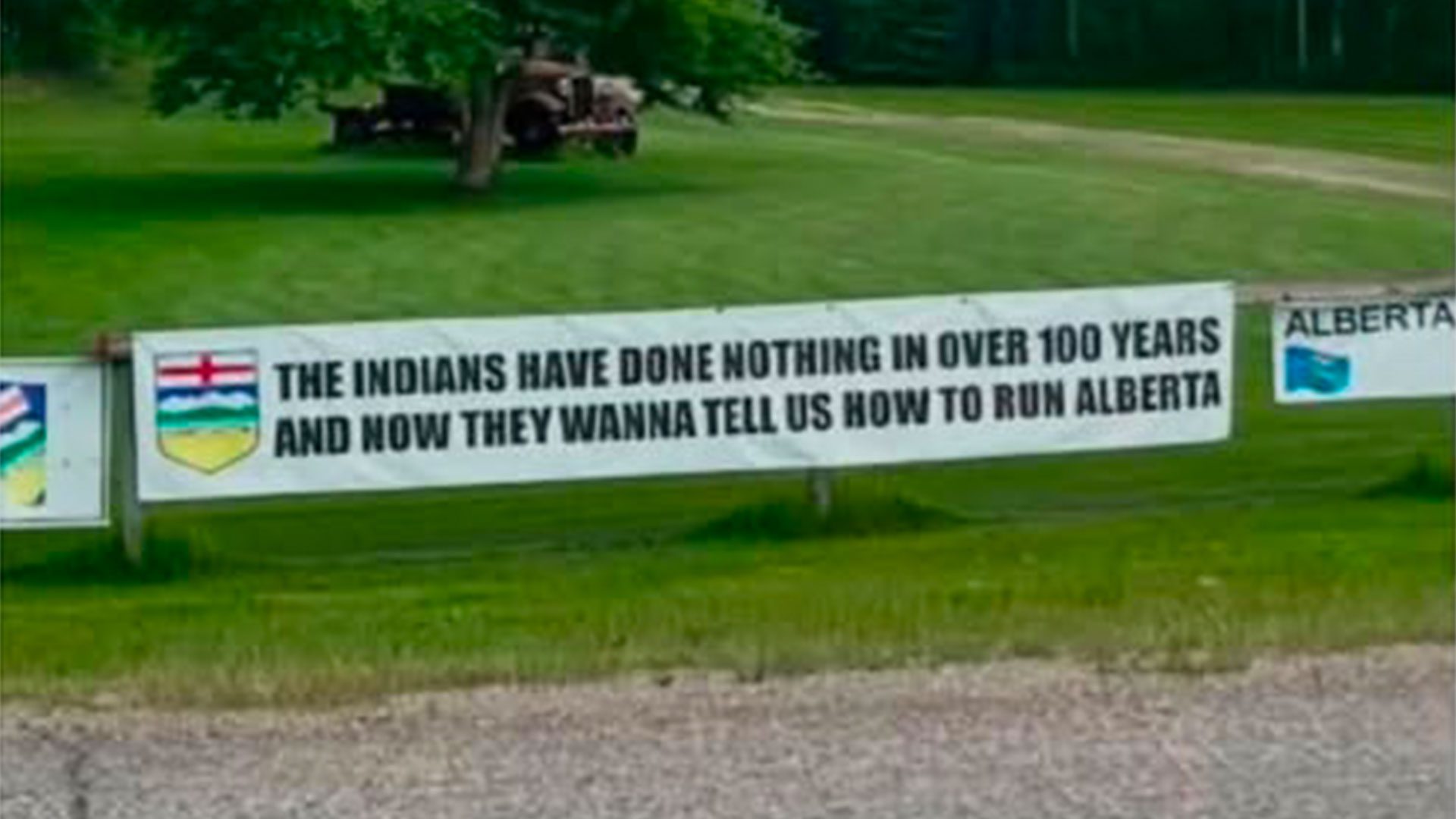
Many of the loudest supporters of Alberta separation hold extremely low opinions of Indigenous peoples despite the province spanning five Treaty territories. Unfortunately, the bigotry, racism, and discrimination continues as we get closer and closer to the referendum dates; the same problematic folks who use “Indian” as a slur in 2026 are also sharing their views on East Asians as well ».
It is very difficult to untangle the caked-on layers of colonial prejudice mixing with the primary demographic of Alberta separation without mentioning white supremacy; holding hands with it you’ll find some version of religious nationalism with hints of Make America Great Again (MAGA) influence applied to Alberta.
If you don’t like what you’ve seen south of the border from the U.S. federal government, you probably won’t like much of what Premier Smith is doing in our province, either. Many of the United Conservative Parties’ political plays have been plagiarized directly from the White House.
If the province of Alberta does indeed separate from Canada, what then becomes of these responses? Who becomes an immigrant when this happens? Who gets to keep (or obtain) their citizenship? Why reform the Senate if it will be part of a nation the province has left? Do new Albertans need to wait to access social services (and what even is a new Albertan) if this new “country” is only a few weeks old?
Maybe even most importantly: how do other Canadians feel about Alberta leaving? Do the other provinces and territories even want this to occur after being taken on a ride by the Alberta government the past few years, ending in tears »?
To add insult to taxpayer-funded injury, the Government of Alberta spent $300,000 on their referendum website ». It does little more than spin a yarn about how hard-done Albertans have been by the federal government while simultaneously blaming immigrants for the province’s social ills. Here is an example of the kind of propaganda that $300k gets you from a former advisor to the Premier:
"Federal policies that almost doubled, and then more than tripled, the number of newcomers in the last decade have negatively impacted our immigration system – putting pressure on Alberta's health, education and other social services, resulting in delayed access to health care for Albertans, larger classrooms for students and unaffordable cost pressures to social services overall."
https://albertareferendum2026.ca/immigration-questions »Alberta’s government is responsible for ensuring healthcare, education, housing, and public infrastructure are funded appropriately; the UCP has been in power for seven of the last ten years. What have they done to ensure funding for public programs and services has kept pace with inflation and per capita population growth? Remember, Premier Danielle Smith specifically asked for increased migration to Alberta in 2024 ».
As a majority government, they are also capable of directly implementing many of the ideas hinted at within these referendum questions. If the Alberta Next panel was any indication », Premier Smith would really like some numbers they can throw around when they legislate these things after October. We suggest you vote to make your voice heard either way!
The official Alberta referendum website mentions that some things haven’t changed or updated since 1867, but that’s hardly a justification to change things in the present. Since that time, we’ve had automobiles, electricity, penicillin, two world wars, 3D movies, feminism, government-funded hockey yaoi, and the rise of personal computers that fit in your pocket. If those haven’t been enough to require changes to the Canadian Constitution, why would a non-binding referendum from Canada’s “richest” province?
Can you trust a provincial government that takes away the rights of teachers & 2SLGBTQ+ youth?
How about one that refuses to consult Indigenous communities prior to declaring several pipeline projects through their lands?
For more reading, visit:
- Elections Alberta - Referendum »
- The Government of Alberta official website for the October 19, 2026 referendum »
- The unofficial website for the October 19, 2026 referendum made by concerned Albertans »
Even more to read through here:
- The 2026 Alberta Referendum: the facts about all 10 questions (Dignity Forum) »
- The Noxious Nine - Alberta’s nasty referendum (Alberta Views) »
- Ten Questions, One Real Decision (Dr. Jared Wesley - Substack) »
- What, exactly, are Alberta separatists mad about? (CBC) »
- What some immigrants could lose if Alberta votes yes to Danielle Smith’s questions (CBC) »
- Does Alberta Provide $10 in Services for Every $1 of ‘Guest Worker’ Taxes? (The Tyee) »
- Alberta’s Separatists Are Chasing a Total Cowboy Fantasy (The Walrus) »
- Scapegoating and Separatists - Why Immigration Is on the Ballot in October (Parkland Institute) »
- No, Alberta Does Not ‘Subsidize’ the Rest of Canada (The Tyee) »
BLOG
Bookkeeping, Payroll, Tax, and more for creatives, entrepreneurs, and small businesses in Edmonton, Alberta, Canada.
We respectfully acknowledge that we are situated on the traditional territories of the Siksika, Kainai, Piikani, Tsuut’ina, Îyârhe Nakoda, Nehiyaw, Dëne Sųłiné, Dane-zaa, Nakota Sioux. These lands are subject to Treaties 4,6,7,8, and 10, and have long served as meeting grounds, travel routes, and gathering places for many diverse First Nations including the Anishinaabe and Haudenosaunee, as well as Métis, and Inuit peoples. We recognize all these Nations and communities, whose rich histories, languages, cultures, and traditions continue to thrive and are key to the enrichment of all our communities.